
Candidates Qualification is Less Serious than Ultimate Frisbee
A straight knock-out like the chess world cup can only ever tell you which player is best, not who is second or third. So why does it qualify 3 players to the candidates? And how could it be better?

At the time of writing the matchups for the round of 32 in the 2025 Chess World Cup have been determined. The bracket has become quite imbalanced as a result of some upsets in one half of the bracket.
Yu Yangyi and Sindarov are the only 2700s left in the top quarter
Awonder Liang and Lê Liêm are the only 2700s left in the second quarter
Pragg, Rapport, MVL and Keymer are all in the third quarter
Wei Yi, Aronian and Eragaisi are in the fourth quarter.
As a result, the top half of the draw offers a far easier path to Candidates qualification than the bottom half.
The biggest winner might be 13th seed Lê Liêm, who can now qualify without beating anyone seeded higher than either 16th seed Sindarov or 17th seed Yu Yangyi. They are effectively playing a completely separate tournament to all the big names in the other half of the draw.
Or, to put it another way, because of the structure of the world cup as a straight knockout with more than one qualification spot, the runner-up will qualify without ever having proven themselves against half of the field.
In the seven double-round-robin candidates tournament was introduced, the nine world cup runners-up have never won, and finished in the top half only 3 times (Svidler 4th= 2016, Ding 4th 2018, Caruana 2nd= 2024)1.
Ultimate Frisbee
Ultimate Frisbee - naturally for a sport originating from 60s hippies - takes proper tournament design more seriously than does FIDE. USA Ultimate runs sectional and regional qualifiers as part of the National Championship cycle. These tournaments often take the form of bracket play, with multiple (and different) numbers of participants and qualification spots available at each tournament.
If they used a straight knockout, then they would have all the same problems as the Chess World Cup. To resolve this, there is the USAU Tournament Format Manual, which specifies the structure for any combination up to a certain size, and which is great reading for someone like me.
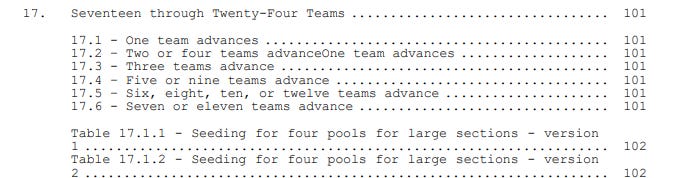
For tournaments with two qualifiers, they use a double elimination bracket. Because the lower bracket is only to determine second place, they forgo the grand final. For a three-qualifiers tournament, they use a shortened triple elimination bracket. The last four teams to be eliminated from the losers’ bracket then play in second losers’ bracket, which eventually determines third place.
So could the World Cup do this? Not really.
The problem is that the losers’ bracket progresses half as fast as the main bracket, as more players are added from the winners bracket each round. When the losers bracket has a round of 16, it reduces to 8 players, but then the winner’s bracket round of 16 adds 8 players back in, so you then need a second losers’ bracket round of 16 to get to a (first) round of 8.
A second losers’ bracket in a triple elimination tournament progresses at one third the speed of the winners bracket, for much the same reason: the losers’ bracket has two ‘rounds of 16’, so the second losers’ bracket needs three of them to handle two sets of 8 players being added from the bracket above.
This is okay for USAU because the largest full double-elimination bracket they do is 16 teams. This makes the longest qualification path is 7 matches (compared to 4 for the tournament winners). But for an 8 round tournament like the world cup, the lower bracket is a 15-match qualification path. Extending the tournament to 45 match days is not going to work.
And a triple elimination bracket is clearly out of the question.
What could work for the Chess World Cup?
If you want to qualify two players, there are some massive improvements available:
Option 1: a double elimination bracket with faster matches. If the losers bracket was played in some kind of ‘fast-classical’, you could play a round (including tiebreaks) in 1 day, and keep up with the main bracket.2 The losers final could revert to regular classical.
Option 2: a double elimination, but with a truncated losers bracket. If you only start the losers bracket at the quarter finals, it’s not so bad: you’ll add two extra rounds for quarter-finals losers.
Option 3: a 2nd-3rd place play-off.3 It’s honestly baffling to me FIDE didn’t do this in years when the world cup had 2 qualification spots. For example, in 2019 MVL came third, only losing to the winner, while Ding qualified as runner-up without facing MVL.4
Any of these methods would at least mean that you don’t guarantee that one of the qualification spots must go to each half of the bracket. So the winner of Lê Liêm, Sindarov and Yu Yangyi would have to beat at least one of the top two from the lower half of the bracket to qualify.5
Or, you could just have a single qualification spot from the world cup.
Afterword
In the event, the players who qualified proved themselves against elite opposition. Sindarov qualified before playing a high seed, but then also won the whole tournament, defeating 7th seed Wei Yi in the final.
The other two qualifiers came from the ‘hard side’ of the bracket: Wei Yi himself took down second seed Erigaisi, while Esipenko had to beat the in-form 6th seed Keymer in the 4th round.
The flaws in the format don’t mean that qualifiers don’t deserve their place at the candidates. Nor does the fact that, this time around, the qualifiers all scored wins against top seeds mean the format’s flaws don’t exist all the same.
Of course, we would always expect a player who was runners-up in the qualifier to perform worse than the winner on average. However, by way of contrast, Nepomniachtchi won in 2020-21 after qualifying Grand Prix runner-up.
If you wanted to torture the players, you could run a triple elimination bracket this way, with the third extra round for the second losers’ bracket on the main bracket’s tiebreaks day.
This is the same as saying, a double elimination starting at the semi-final.
MVL eventually did qualify for the candidates via a second rating spot when Radjabov withdrew. He went on to place second in the candidates.
For similar reasons, if a player has already qualified via another path or withdraws, FIDE should not award it to the next-placed finisher.